
Table of Contents
Most people get this wrong: SEO isn’t about targeting one keyword per page anymore.
Google evaluates topics, search intent, and relationships between queries. When websites create multiple pages targeting slight keyword variations, those pages often end up competing against each other instead of ranking together.
This is where keyword clustering comes in.
If you’ve ever wondered what is keyword clustering, it’s the process of grouping related keywords that share the same search intent so they can be targeted on the same page.
I’ve used keyword clustering across SaaS websites, local businesses, affiliate sites, and content-heavy blogs. In nearly every case, it helped reduce keyword cannibalization, build topical authority, and create pages that ranked for dozens of related search terms.
In this guide, you’ll learn what keyword clustering is, why it matters, how to create keyword clusters, and how to use them to improve your SEO strategy.
What Is Keyword Clustering?
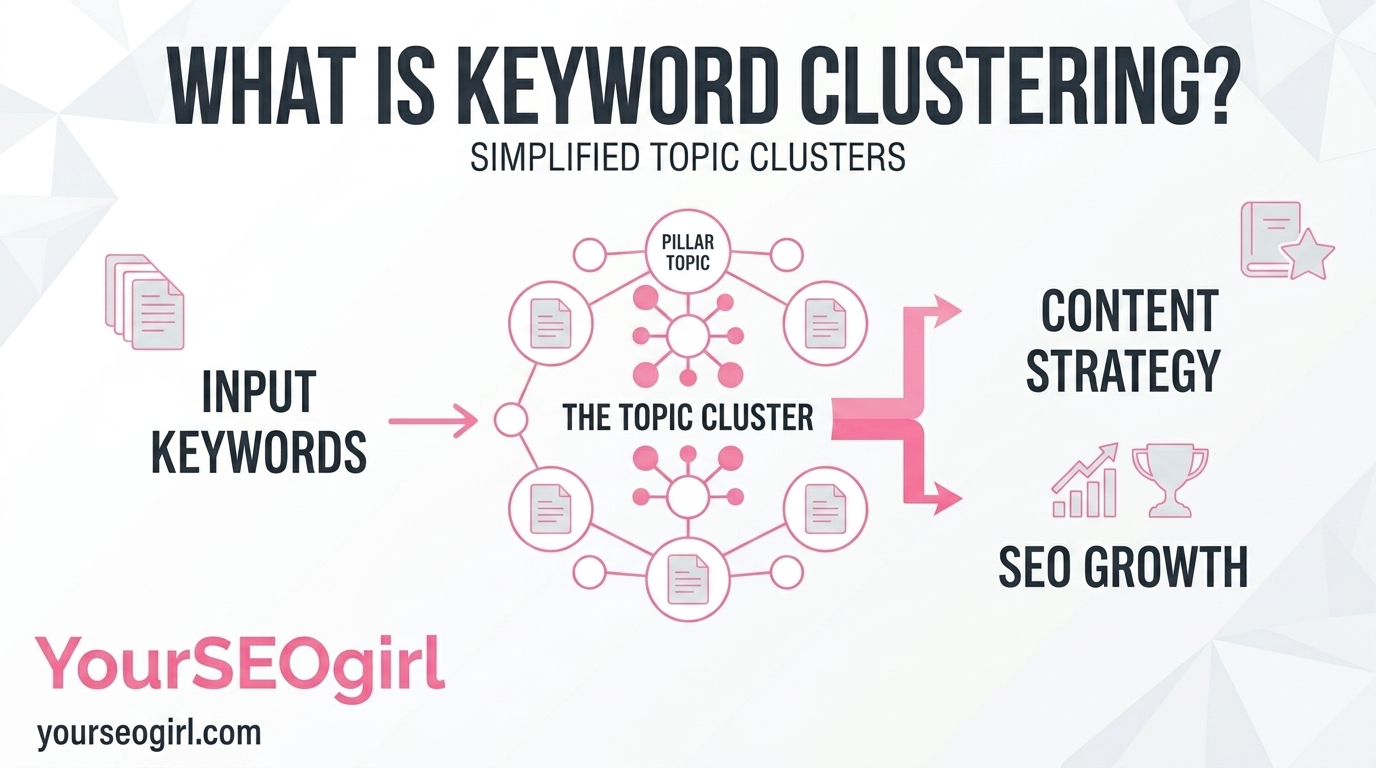
Keyword clustering is the process of grouping related keywords that share the same search intent and can be targeted on the same page. The goal is to improve topical relevance, reduce keyword cannibalization, and increase visibility across multiple search terms.
Let’s be clear: if you’re wondering what is keyword clustering, it’s the practice of grouping related search terms into a single “keyword cluster” based on shared search intent and similar SERP results.
In plain English, you collect all the ways people search for the same thing and plan one page (or a small hub) to satisfy that intent thoroughly. That’s what keyword clustering in SEO is designed to do—map queries to the right content so you don’t create five thin pages that compete with each other.
Most people get this wrong. They group synonyms and call it a day.
What actually matters is intent.
If the top-ranking pages for “best budget running shoes” and “top cheap running shoes” largely overlap, Google sees those as the same intent—so they belong in one cluster.
If the SERPs look different, they should be separate pages, even if the wording feels similar.
Why does keyword clustering help pages rank for multiple terms? Because one strong, comprehensive page can naturally pick up dozens (sometimes hundreds) of variations: long-tails, modifiers, and common questions.
You avoid keyword cannibalization, concentrate backlinks and engagement signals on one URL, and give Google a clear, authoritative answer. The result: broader visibility and less content bloat.
Quick, practical examples (yes—real keyword clustering examples):
Example 1: Keywords That Belong in the Same Cluster
Primary keyword:
- running shoes for flat feet
Supporting keywords:
- best running shoes for flat feet
- running shoes for overpronation
- best stability running shoes
- supportive running shoes for women
- supportive running shoes for men
Why? These keywords typically return similar roundup-style pages and satisfy the same search intent: finding supportive running shoes.
Result: One page targeting the entire cluster.
Example 2: Keywords That Should Be Separate Pages
| Keyword 1: | Keyword 2: |
| email marketing templates | cold email templates |
Why? Although they sound similar, the search intent is different.
People searching for email marketing templates usually want newsletters, promotional emails, or campaign examples.
People searching for cold email templates usually want sales outreach and prospecting examples.
Result: Two separate pages.
Example 3: Local SEO Cluster
Primary keyword:
- roof leak repair
Supporting keywords:
- emergency roof repair
- same-day roof repair
- roof leak repair [city]
Why? These keywords often return similar local service pages and target the same user need.
Result: One service page, potentially supported by an emergency repair section or FAQ.
So, what are keyword clusters in practice?
They’re groups of queries that deserve the same page because users want the same outcome. How to cluster keywords quickly: pull a keyword list, check SERP overlap (manually or with a tool), group by intent, and choose a primary target with a handful of secondary variants. That’s how to do keyword clustering without overthinking it.
If you’re asking “how do I create keyword clusters for my blog” or “how can I use keyword clustering to improve my SEO,” start small.
Pick one topic, identify 5–10 close variants with matching SERPs, and build a single, well-structured page. Add clear H2s, short FAQs, and examples.
You’ll cover more ground with less content—and give your site a cleaner, more strategic foundation.
What Is a Keyword Cluster?
A keyword cluster is a group of closely related search terms that share the same search intent and can be targeted together with one strong page (or a hub-and-spoke set of pages).
Think of it as organizing your ideas by how people actually search, not by single phrases. Instead of writing one post for “best running shoes” and another for “top shoes for runners,” you group them and build one page that answers the whole intent fully.
A keyword is just a single query.
A keyword cluster is a strategic set of queries that belong together because the SERP shows similar results, and the intent is essentially the same.
One keyword = one phrase. One cluster = one intent covered comprehensively.
That’s what is keyword clustering in SEO—mapping related queries to the right page so you can rank for many terms without creating duplicate content.
If you’re wondering, “can you show keyword clustering examples?”, here are a few simple ones:
- Cluster: On-page SEO audit
- on-page seo checklist
- how to do an on-page seo audit
- on-page seo factors
- on-page optimization steps
- Cluster: Keyword clustering
- what is keyword clustering
- keyword cluster
- how to cluster keywords
- how to use keyword clustering
- what are keyword clusters
- Cluster: Pour-over coffee (non-SEO example)
- how to make pour over coffee
- pour over coffee ratio
- best pour over kettles
- pour over vs drip
| Primary Keyword | Supporting Keywords |
| what is keyword clustering | keyword cluster, keyword clustering in SEO, what are keyword clusters, cluster keywords |
The primary keyword becomes the main target of the page, while supporting keywords are naturally incorporated throughout headings, examples, FAQs, and body content.
Let’s be clear on why clusters matter: they prevent keyword cannibalization.
Cannibalization happens when multiple pages on your site target the same or very similar queries. Google gets mixed signals, your pages compete with each other, and rankings wobble. When you use keyword clustering, you:
- Map one primary page to one intent (with supporting subtopics).
- Consolidate content instead of splitting it across thin pages.
- Build internal links from related content to the main page to reinforce relevance.
What actually matters is aligning content to intent.
If the SERP for five queries shows the same types of pages ranking, they belong in one cluster and should point to a single, comprehensive resource.
This makes it easier to rank for dozens (sometimes hundreds) of variations from one high-quality page—and it reduces the chaos of guessing how to do keyword clustering after the fact.
Why Is Keyword Clustering Important for SEO?
Keyword clustering helps you organize related keywords into a clear content strategy instead of creating separate pages for every keyword variation.
When done correctly, it helps reduce keyword cannibalization, improve topical authority, and create pages that rank for multiple search terms instead of just one.
It also makes content planning easier. Rather than guessing what to publish next, you can group related topics, identify content opportunities, and build pages that work together instead of competing with each other.
For both users and search engines, the result is a cleaner website structure, stronger relevance, and a more scalable SEO strategy.
Keyword Clustering vs Topic Clusters
Most people get this wrong: keyword clusters and topic clusters aren’t the same thing. They work together, but they solve different problems.
A keyword cluster is a group of search queries that share the same intent and similar SERP results, so they can be targeted with one page. If you’ve ever asked “what is keyword clustering in SEO?”—it’s the process of finding and grouping those semantically related queries. Think: how to cluster keywords so one page can rank for many variations without cannibalizing others.
Quick keyword clustering examples:
- “best running shoes,” “top running shoes,” “best shoes for runners,” “best running shoes 2026” → one commercial-intent review page.
- “how to brew French press,” “French press ratio,” “French press brew time” → one in-depth how-to guide.
On the other hand, a topic cluster is a content architecture. It’s a pillar page that covers a broad topic at a high level, supported by interlinked subpages that go deep on subtopics. The goal is topical authority and clean internal linking—not just ranking for one cluster.
Example topic cluster:
- Pillar: “Complete Guide to Marathon Training”
- Supporting pages: “16-Week Marathon Plan,” “Fueling and Nutrition,” “Injury Prevention,” “Best Running Shoes,” “Race Day Strategy”
Notice how one of those supporting pages (“Best Running Shoes”) could be driven by the keyword cluster we listed earlier. That’s the connection.
Let’s be clear on the differences:
| Aspect | Keyword Clusters | Topic Clusters |
| Purpose | Group queries by intent/SERP to target with one page | Organize a content hub around a broad topic |
| Unit | Queries | Pages (pillar + supporting) |
| Output | One primary page with secondary keywords | Multiple interlinked pages |
| Wins | Avoid cannibalization, expand query coverage | Build topical authority, improve internal linking and UX |
How keyword clusters support topic cluster strategies:
- Define what each page should rank for: You use keyword clustering to decide the primary and secondary terms for your pillar and each supporting article.
- Prevent overlap: Clusters help you avoid creating two pages competing for the same intent.
- Strengthen internal links: Anchor text can naturally use cluster phrases while pointing users to the right depth page.
- Build better briefs: Each page brief pulls from its keyword cluster: user intent, subhead ideas, FAQs, and examples.
If you’re asking “how can I use keyword clustering to improve my SEO?” or “how do I create keyword clusters for my blog?”, start simple:
- Collect queries from your tools, search suggestions, and competitor pages.
- Group by intent and SERP similarity (if the top results overlap, they likely belong together).
- Map each cluster to one page in your topic cluster: head terms → pillar, narrower intents → supporting pages.
What actually matters is this: keyword clusters decide what each page targets; topic clusters decide how those pages work together to earn trust, depth, and rankings.
Types of Keyword Clustering
Let’s break down the three main ways SEOs build a keyword cluster—and when each one makes sense.
Manual Keyword Clustering
If you’ve ever sorted a big keyword list in a spreadsheet, you’ve done this. You export your keywords, remove junk, then group terms by shared modifiers (best/compare/near me), intent (informational vs. transactional), and themes. You’ll often:
- Create tabs for core topics.
- Color-code by intent.
- Stack close variations under a single primary keyword.
Example: “best project management tools for startups,” “project management software for startups,” and “startup project management tool” likely live in one group because the intent is the same.
Pros:
- Deep editorial control—you learn the language of your audience.
- Great for smaller sites or narrow niches.
- Helps with on-page planning and internal linking.
Limitations:
- Slow and subjective. Two people cluster the same list differently.
- Hard to scale past a few hundred keywords.
- Can miss how Google actually groups queries.
SERP-Based Keyword Clustering
Here, you cluster based on SERP overlap. If two keywords share enough ranking URLs (e.g., 3–5 out of the top 10), they likely deserve one page. If the overlap is thin, they probably need separate pages. This mirrors how Google evaluates intent.
Why many SEOs prefer it:
- It’s data-driven and reduces guesswork.
- It prevents cannibalization because you’re following the live SERP.
- It scales well with tools and scripts.
Example: If “best small business CRM” and “CRM for small business” share 7/10 results, that’s one page with a single primary intent.
Caveats:
- SERPs are fluid by location and time. Re-check critical clusters.
- Edge cases exist: seasonal swings, news spikes, and mixed-intent SERPs can mislead the overlap.
Semantic Keyword Clustering
This groups terms by meaning using NLP/embeddings and entity relationships, not just shared SERP results. It spots synonyms, related concepts, and topic neighbors—even when SERPs don’t overlap.
How it differs from SERP overlap:
- Semantic clustering asks, “Do these queries talk about the same concept?” while SERP overlap asks, “Does Google rank the same pages for both?”
- You might semantically group “running cadence” and “steps per minute,” even if today’s SERPs diverge based on audience or format.
Benefits:
- Excellent for building topic clusters and mapping internal links.
- Surfaces content gaps (supporting articles, FAQs, glossary pages).
- Future-proof when SERPs evolve but the concepts remain tied.
Limitations:
- Can over-group queries that deserve distinct pages right now.
- Requires judgment and, often, tooling.
- Best used with a SERP check to avoid intent mismatches.
If you’re asking what is keyword clustering in SEO or how to cluster keywords without guesswork, combine methods. Use SERP overlap to decide page count, use semantic clusters to build the surrounding content system, and use manual review to keep it human. That’s how you turn “what are keyword clusters” into a practical plan you can ship.
For most websites, I recommend combining SERP-based clustering with manual review.
SERP overlap shows how Google interprets a topic, while manual review helps identify edge cases that automated tools often miss.
This is the approach I use when building content plans because it balances scalability with accuracy.
When Keywords Should Not Be Clustered
Most people get this wrong: just because two keywords look similar does not mean they belong in the same cluster.
Keywords should usually be separated when the intent, SERP, page type, or funnel stage changes.
Search Intent Differs
Example: “what is keyword clustering” and “best keyword clustering tools” look related, but they are not the same intent. One user wants education. The other wants software recommendations.
SERPs Differ Significantly
If Google shows a different set of ranking pages for two keywords, that is a strong sign the keywords deserve separate pages. Similar wording does not matter if the actual search results solve different problems.
Page Type Differs
Example: “keyword clustering guide” belongs on an educational blog post, while “keyword clustering tool” belongs on a tool landing page. Trying to target both equally on one URL can weaken the angle and create cannibalization.
Funnel Stage Differs
Example: “what is keyword clustering” is top-of-funnel and informational. “keyword clustering software pricing” is bottom-of-funnel and transactional. They should not be forced into one page.
When in doubt, trust the SERP. If Google treats two keywords differently, your content structure should too.
How to Do Keyword Clustering
If you’ve been wondering what is keyword clustering and how to do keyword clustering without drowning in spreadsheets, here’s a clean, repeatable workflow that works.
1) Gather Keywords
Start wide, then narrow.
- Use tools: Google Search Console, Ahrefs, Semrush, Moz, and free sources like Google Autocomplete, People Also Ask, and Related Searches.
- Mine competitors: export their ranking keywords, scan their sitemaps and top pages.
- Expand seeds: take a core term (e.g., “keyword clustering”) and add modifiers like “how to,” “examples,” “tools,” “template,” “for blogs,” “for ecommerce.”
- Listen to users: pull questions from Reddit, Quora, and your support inbox. These are gold for intent.
Tip: Keep everything in one sheet with columns for Keyword, Intent, Volume, Difficulty, URL (if you already target it), Notes.
2) Analyze Search Intent
Most people get this wrong. Match the query to what the searcher actually wants.
- Informational: the user wants to learn (“what is keyword clustering in SEO”, “how to cluster keywords”). SERPs show guides, definitions, videos.
- Commercial: the user is comparing options (“best keyword clustering tools”, “keyword cluster software”). Expect listicles and comparison pages.
- Transactional: the user is ready to act (“buy keyword tool”, “pricing”, “demo”). You’ll see product pages and sign-up CTAs.
3) Group Similar Keywords
This is where things break down if you only look at synonyms.
- SERP overlap: check the top 10 results for two keywords. If 3+ URLs are the same, they likely belong in the same keyword cluster. For example, “what are keyword clusters” and “what is keyword cluster” often share the same results.
- Intent matching: “how to cluster keywords” (tutorial) should not live with “keyword clustering tools” (software shopping).
- Semantic relevance: group closely related phrasing and entities, not just exact matches. Keep “examples” queries together if the SERP expects examples.
4) Select Primary Keywords
Choose one primary per cluster.
- Pick the phrasing with the best mix of search volume, clear intent, realistic difficulty, and business value.
- The rest become supporting keywords you’ll cover in subheadings, FAQs, and body copy. They help you rank for variations like “how can I use keyword clustering to improve my SEO” or “how do I create keyword clusters for my blog.”
5) Create Content Around Clusters
Turn clusters into pages — one page per cluster.
- Content mapping: assign each cluster to a specific URL to avoid cannibalization. Pillar pages can target broader clusters; subposts can dive into “tools,” “process,” or “examples.”
- Page targeting: use the primary keyword in the title, H1, and URL slug. Weave supporting terms naturally in H2s and sections. Add a short “can you show keyword clustering examples?” section if the cluster expects it.
- Interlink related pages: to build topical authority and guide users through the journey.
Do this consistently = you’ll stop guessing, and start publishing pages that rank and convert.
Keyword Clustering Example: Informational vs. Transactional Intent
Let’s say that want to promote a keyword clustering tool. A common mistake would be trying to rank one page for all of these keywords:
• what is keyword clustering
• keyword clustering tool
• free keyword clustering tool
• best keyword clustering tool
• keyword clustering software
Although they appear related, they represent different search intents.
- The keyword “what is keyword clustering” is informational and belongs on an educational guide like this one.
- The keywords “keyword clustering tool” and “free keyword clustering tool” are transactional and belong on a dedicated tool page.
Separating educational and transactional intent reduces cannibalization and gives both pages a stronger chance of ranking: the blog teaches the concept, while the tool page captures users who are ready to use a solution.
Example of an Automated Keyword Cluster
Here’s an example of what a completed keyword cluster could look like inside the YourSEOgirl Keyword Clustering Tool.
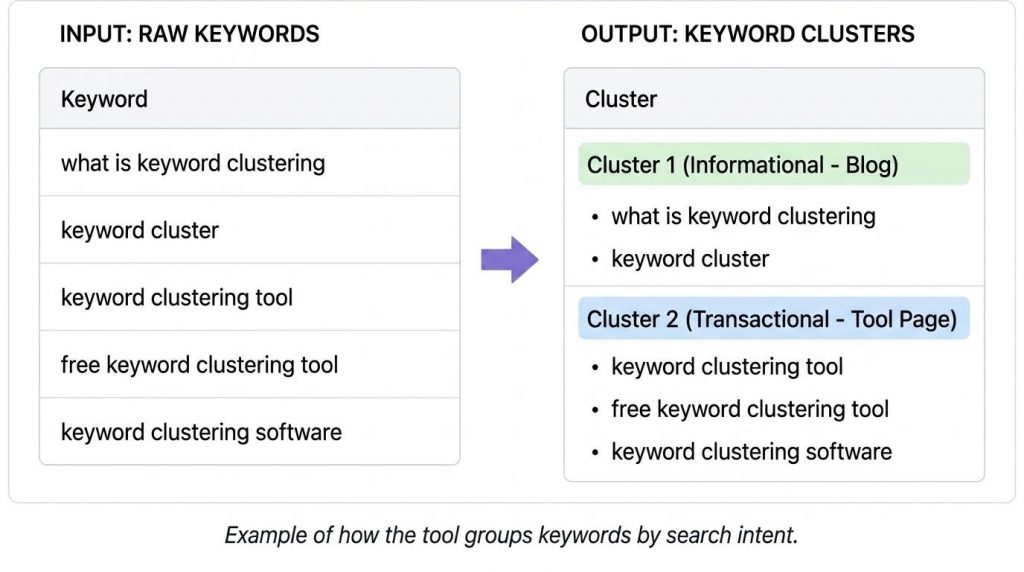
Instead of manually reviewing hundreds of keywords and SERPs, the tool groups related keywords by intent and topic, helping identify which keywords belong on the same page and which should be separated into different content assets.
This saves hours of manual work while creating a cleaner content strategy.
How I Used Keyword Clustering to Build the YourSEOgirl Website and Tool
When building the YourSEOgirl website and Keyword Clustering Tool, I ran into a challenge that many website owners face:
Should all keyword clustering keywords be targeted on one page, or should they be separated into different pages?
At first glance, terms such as:
- what is keyword clustering
- keyword cluster
- how to cluster keywords
- keyword clustering tool
- free keyword clustering tool
- keyword clustering software
all seem closely related.
However, after reviewing the search results and analyzing search intent, it became clear that they did not belong on the same page.
The keywords “what is keyword clustering,” “keyword cluster,” and “how to cluster keywords” are informational. People searching these terms want to learn what keyword clustering is, how it works, and how to apply it.
On the other hand, keywords such as “keyword clustering tool,” “free keyword clustering tool,” and “keyword clustering software” are transactional. Users searching these terms are looking for a solution they can actively use.
Because of that, I made a deliberate decision to separate the content into two different assets:
Why I Built My Own Keyword Clustering Tool
While creating content for YourSEOgirl, I found that many keyword clustering tools focused only on grouping similar phrases. The problem is that similar phrases do not always belong on the same page.
To solve this problem, and ensure I’m hitting the search intent, I built my own Keyword Clustering Tool that analyzes keywords based on search intent and page type rather than simply grouping similar words together.
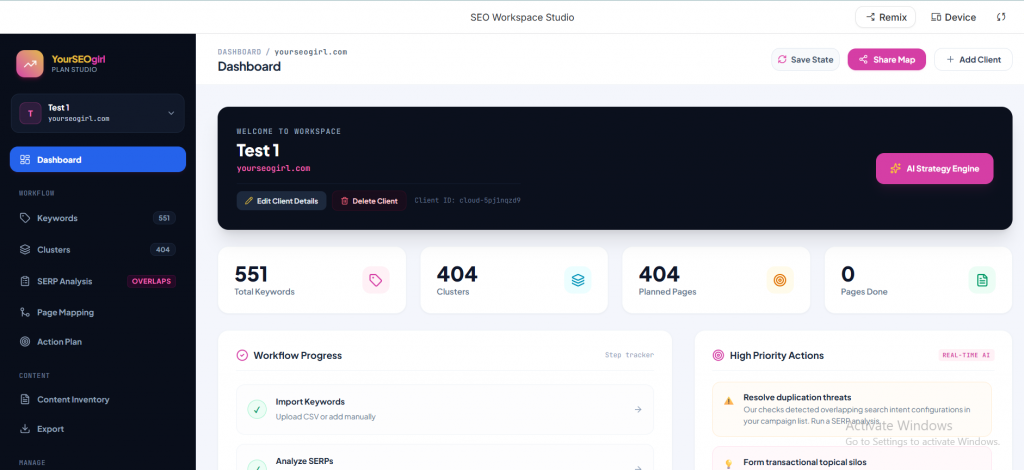
The same process was used while planning this article and the supporting Keyword Clustering Tool page.
By reviewing search intent first and SERP overlap second, I was able to create separate content assets that target different stages of the user journey while avoiding keyword cannibalization.
The screenshots below show an example of how the tool separates informational and transactional keywords into different clusters and recommends the appropriate page type for each.
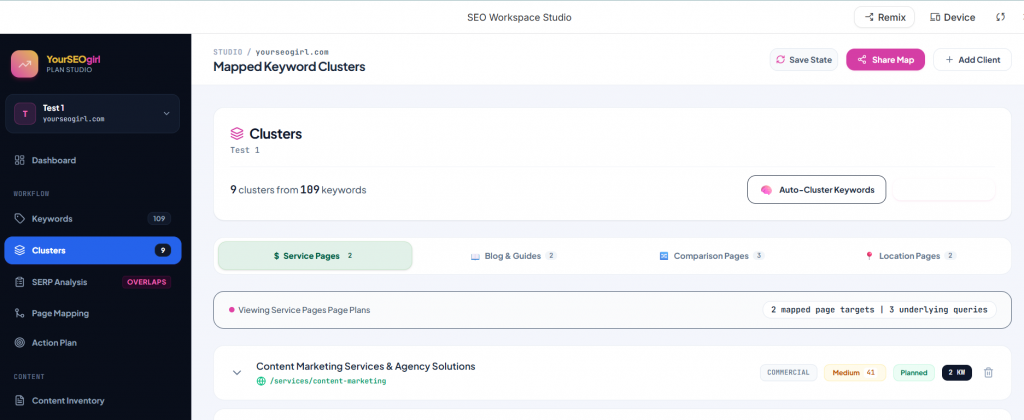
By separating those intents, pages can focus on a specific audience without competing against each other.
This reduces keyword cannibalization, creates a clearer site structure, and improves the likelihood of ranking for both informational and transactional searches.
This is the same process I use when creating content strategies and keyword maps: analyze search intent first, review SERP overlap second, and only then decide whether keywords belong together or deserve separate pages
How to Use Keyword Clustering in Your SEO Strategy
Keyword clustering isn’t a spreadsheet trick — it’s your content plan. If you’re still asking “what is keyword clustering in SEO?” think of it this way: a keyword cluster is a set of closely related searches that reflect the same intent or topic angle. You don’t write 20 thin posts for 20 similar keywords. You plan one strong page per intent and support it with related pieces that deepen coverage.
How to use that for content planning:
- Start with your core topic and group queries by intent (informational, comparison, transactional). This is how to cluster keywords without guesswork.
- Prioritize clusters by business value and difficulty. Not every cluster deserves a page right now.
- Map clusters to formats: guides, comparisons, checklists, calculators, FAQs.
- Build briefs that list the primary query, 3–5 support queries, search intent, and internal links.
Pillar pages make this system work. Your pillar is the comprehensive hub that answers the broad question and frames the journey. It targets the biggest cluster (often the “what is” or “ultimate guide”) and links out to supportive posts that tackle sub-intents. Keep your pillar scannable with a clear table of contents, short sections, and prominent links to every supporting article. Update it as new spokes go live — that freshness and depth signal topic authority.
Internal linking is where most people get this wrong. Use a simple hub-and-spoke model:
- Every supporting article links back to the pillar using natural anchor text.
- The pillar links to every supporting article in-context (not just in a footer list).
- Interlink sibling posts when it benefits the reader (e.g., “best for flat feet” → “how to choose running shoe size”).
- Add breadcrumbs and a consistent related-posts block to reinforce the cluster.
This is how you build topic authority: cover the cluster completely, publish in tight bursts (so Google can see the structure), answer real questions with examples, and keep content unified by the same terminology, design, and schema.
Over time, your cluster sends a clear signal that you’re the best resource on the topic, which is how keyword clustering actually improves SEO.
A quick example (because “can you show keyword clustering examples?” is a fair ask): say your topic is “running shoes.”
- Pillar: “The Complete Guide to Running Shoes.”
- Supporting pages: “Best running shoes for flat feet,” “Trail vs. road shoes,” “How to choose running shoe size,” “Neutral vs. stability,” “Best budget running shoes.”
That’s a clean cluster. If you’re wondering “how do I create keyword clusters for my blog?” — follow this pattern, then execute.
Keyword Clustering Examples
Let’s make “what is keyword clustering” real with three quick scenarios. Clusters aren’t about cramming similar words onto a page. They’re about grouping queries that share the same search intent and SERP type, so one page can win multiple keywords without cannibalizing others.
Local SEO Example: “Plumber in Austin”
Most people get this wrong by mixing hire-now terms with research terms. Split by intent and page type.
- Hire-now cluster (service + geo; shows Local Pack and service pages):
- plumber austin
- emergency plumber austin
- 24 hour plumber austin
- drain cleaning austin
- Research/pricing cluster (informational; guides and FAQs):
- plumber austin cost
- water heater installation cost austin
- how much does a plumber charge in austin
- “Best”/list cluster (roundups; typically third-party listicles in SERPs):
- best plumbers in austin
- top rated plumbers austin
Why this works: the first group maps to a location landing page and service pages; the second is a pricing guide; the third is a roundup page (or skip it if you’re a single business and instead target “plumber prices in austin” to capture researchers). What actually matters is matching SERP format and intent.
SaaS SEO Example: Time Tracking Software
This is where things break down if you try to rank a single “features” page for everything.
- Commercial category cluster (category/solutions page):
- time tracking software
- time tracking app for freelancers
- time tracking software for small business
- best time tracking apps
- Comparisons/alternatives cluster (comparison pages; list and head-to-head):
- harvest alternatives
- toggl vs clockify
- harvest vs toggl
- [your brand] vs toggl
- Job-to-be-done/How-to cluster (playbooks; blog + templates):
- how to track billable hours
- timesheet template google sheets
- DCAA compliant timesheets
- automate time tracking in slack
Clustering decision: “Best” and “software” terms show category/list SERPs; “vs/alternatives” require comparison formats; how-tos favor tutorials and templates. Build one category pillar, a comparison hub with individual “X vs Y” pages, and a playbook library that naturally funnels to your product.
eCommerce SEO Example: Running Shoes
Intent dictates structure and creates upsell/cross-sell opportunities.
- Transactional category cluster (PLP):
- men’s running shoes
- stability running shoes
- wide running shoes
- Problem/benefit cluster (editorial buying guides):
- best running shoes for flat feet
- best running shoes for plantar fasciitis
- best cushioned running shoes
- Product assistance cluster (PDP support + blog):
- nike pegasus 40 sizing
- brooks ghost 15 vs glycerin 20
- how long do running shoes last
Content opportunities:
- Add comparison tables to buying guides (filters: arch, cushioning, drop).
- Create evergreen “fit and sizing” hubs and link from every PDP.
- Use internal links from guides to PLPs/PDPs with consistent anchor text.
- Implement structured data (Product, Review, FAQ) to win rich results.
If you’re asking how to do keyword clustering and how to use keyword clustering to improve your SEO, start by auditing SERPs, group by page type and intent, then map one cluster to one page. That’s how you avoid cannibalization and build topical authority fast.
Common Keyword Clustering Mistakes
Most keyword clustering fails not because the tools are bad, but because the logic behind the grouping is off. If you’re still figuring out what is keyword clustering in SEO or how to cluster keywords for your blog, avoid these easy-to-make traps.
Clustering by “Similar Words” Only
Two phrases can look alike but serve totally different needs. “best project management software” is a comparison intent; “what is project management software” is educational. Lumping them together gives you a page that tries to do everything and does nothing well.
Fix: Group by SERP overlap and intent, not just wording. If the top 5–10 results mostly match across queries, they likely form one keyword cluster.
Ignoring Search Intent
Most people get this wrong because they don’t label intent before clustering. “CRM pricing” (transactional) and “how does a CRM work” (informational) should never live on the same page.
Fix: Tag every keyword with intent (informational, commercial, transactional, navigational). Build clusters around one dominant intent. This is how to do keyword clustering that actually ranks.
Creating Overly Broad Clusters
This is where things break down. You don’t need a single hub page to cover “keyword clustering,” “keyword clustering tools,” “how to use keyword clustering,” and “keyword clustering examples” all at once. That page will be vague and underperform.
Fix: Use the “one main job per page” rule. If a topic needs different depth or a different format (guide vs tool roundup vs examples post), split it.
Splitting Keywords That Belong Together
On the flip side, some folks fragment a tight topic. If “how to cluster keywords” and “how do I create keyword clusters for my blog” pull near-identical SERPs, they’re one page, not two.
Fix: Check SERP sameness. If the rankings heavily overlap, merge them and optimize one stronger page.
Creating Multiple Pages for the Same Cluster (Cannibalization)
You publish a “what is keyword clustering” explainer, then a “what are keyword clusters” post a month later. Now both compete—and both slip.
Fix: Map keywords to URLs before publishing. If two drafts target the same cluster, consolidate and redirect the weaker one.
Quick Check Before You Hit Publish:
Here’s what you should always check before you hit publish:
- Does this page answer one clear intent?
- Do its keywords share SERP results?
- Would a searcher expect one page or multiple resources here?
- Am I forcing synonyms onto separate pages without a reason?
What actually matters is being ruthless about intent and evidence from the SERPs. Get that right, and your clusters turn into clean architecture, stronger relevance, and easier wins.
Common Signs Your Keyword Clustering Needs Improvement
Even if you’re publishing content regularly, poor keyword clustering can limit your results. Overlapping pages, unclear targeting, and inconsistent content planning often make it harder for search engines to understand which page should rank.
Common warning signs include:
- Multiple pages targeting the same keyword
- Rankings fluctuate between URLs
- Similar articles compete with each other
- Content planning feels chaotic
- Internal linking lacks structure
- If you recognize several of these issues, your content strategy may benefit from a clustering review before publishing additional content.
If you recognize several of these issues, your content strategy may benefit from a clustering review before publishing additional content.
Keyword Clustering Best Practices
Keyword clustering only drives results when it mirrors how Google groups ideas on the page. Most people get this wrong by clustering from a spreadsheet. Don’t. Go SERP-first, then refine.
- Start SERP-first, not tool-first: Open the top 5–10 results for your candidate queries. If the same pages rank for “project management software,” “best project management tools,” and “task management app,” Google sees shared intent—those keywords likely belong in one keyword cluster. If “how to create a project plan” surfaces guides and templates (and not product pages), that’s a separate cluster.
- Group by search intent (informational, commercial, transactional, navigational)
Let’s be clear: intent is what actually matters. “How to cluster keywords” is informational; “best keyword clustering tools” is commercial. Mixing them in one page confuses both users and rankings. Your clusters should reflect one dominant intent per page. - Choose one primary keyword per page
You can rank for dozens of variations, but you need one clear target to anchor your title, H1, and angle. If you’re still wondering what is keyword clustering in SEO, this is it in practice: define the main query, then build around it. Supporting terms (what are keyword clusters, keyword cluster examples) fit naturally in subheads and body copy. - Use supporting keywords naturally (no stuffing)
Write like a human. Cover subtopics people expect: definitions, steps, tools, pros/cons, and examples. If you’re teaching how to do keyword clustering, include a quick process, show a mini example, and answer a couple of “but what about…” questions. That depth signals relevance without cramming synonyms. - Build supporting internal links across the cluster
Map a simple structure:- Pillar page (broad topic, e.g., “What is keyword clustering”) links to detailed subpages (e.g., “How to use keyword clustering for content planning”).
- Subpages link back to the pillar with descriptive anchor text.
- Lateral links connect siblings when it helps the reader.
- Review clusters regularly (quarterly is fine)
SERPs shift. New competitors enter. Intent evolves. Reopen your clusters: - Re-scan the SERP: did formats change (videos, product carousels, forums)?
- Consolidate thin pages; split bloated ones.
- Update internal links and on-page headings to match refined intent.
- Don’t build mega clusters.
Don’t Build Mega Clusters
One mistake I frequently see is placing 100–200 keywords into a single cluster because they look similar.
A cluster should represent a single intent. If a keyword requires a different page type, a different funnel stage, or a different SERP result, it likely deserves its own cluster.
For example, “keyword clustering examples” may work as part of an educational guide, but “best keyword clustering tools” usually deserves a separate commercial page because the user is comparing solutions.
Quick example: Say your primary is “keyword clustering.” You might build:
- Pillar: What is keyword clustering (definition, why it matters, high-level process)
- Guides: How to cluster keywords (step-by-step), how to use keyword clustering for blogs, keyword clustering examples (with screenshots)
- Compare: Manual vs. tool-based clustering
Do this, and you won’t just rank — you’ll make your entire topic easier to navigate, which is exactly what Google and your readers want.
How Keyword Clustering Improves SEO
Keyword clustering turns scattered posts into a focused SEO system. Instead of writing one page per keyword, you group closely related queries into a single “keyword cluster,” then build one strong page (and a few smart supporting pieces) to cover them.
If you’ve ever wondered what is keyword clustering in SEO and why it works, here’s the payoff.
- Rank for more keywords: A well-structured page built around a keyword cluster can naturally include variations, synonyms, and long-tail phrases. One guide can pick up impressions for “how to use keyword clustering,” “what are keyword clusters,” and “how to cluster keywords” without feeling stuffed. You’re aligning with search intent, so Google sees one comprehensive answer—not ten thin ones.
- Build topical authority: Clusters help you cover a subject end-to-end. You create a pillar page that answers the broad query and supporting articles that go deeper on subtopics. Over time, this signals to search engines that you’re the go-to on the topic. It’s not about volume; it’s about depth and coherence.
- Reduce cannibalization: Most people get this wrong. Publishing multiple posts targeting near-identical terms splits your equity and confuses Google. Clustering maps related queries to a single primary URL, so you stop competing with yourself. If two posts overlap, you consolidate, redirect, and let one page win.
- Scale content with a system: Clustering makes planning repeatable. You research once, group terms by intent, then create briefs in batches. That means faster production, consistent on-page structure, and fewer rewrites. It also helps answer, “how do I create keyword clusters for my blog?”—you’re building a content assembly line that still feels human.
- Strengthen site architecture: Pillar-and-supporting pages form a clear hub-and-spoke model. Internal links flow logically from the pillar to specific guides and back up again. Crawlers understand your hierarchy, users find answers faster, and authority circulates to the pages that need it most.
Quick example to make it real: targeting “email marketing automation.”
Your cluster could include “what is email automation,” “email workflow examples,” “best email automation tools,” and “how to set up automated emails.” The pillar is a complete guide. Supporting posts cover tools, tutorials, and examples.
Together, they rank for more terms, avoid overlap, and keep your internal links tight. If you’ve asked, “how can I use keyword clustering to improve my SEO?”—this is it.
Let’s be clear: the goal isn’t to cram every phrase into one mega page.
It’s to group intent-aligned queries, assign them to the right URL, and build a structure that scales. That’s what is keyword clustering, done right.
Conclusion
Keyword clustering is the process of grouping related keywords based on search intent and SERP similarity so they can be targeted on the same page.
When done correctly, it helps reduce keyword cannibalization, build topical authority, improve internal linking, and create a more scalable content strategy.
The key is to focus on intent, not individual keyword variations. If multiple keywords satisfy the same user need and produce similar search results, they often belong in the same cluster.
Before creating your next piece of content, review your keyword list, identify overlapping intent, and map each cluster to a single page. The result is a cleaner site structure, stronger rankings, and content that works together instead of competing against itself.
If you’d like to speed up the process, try the YourSEOgirl Keyword Clustering Tool to automatically group keywords and identify page opportunities.
Frequently Asked Questions
Got questions? Here are quick, straight answers you can actually use.
What is a Keyword Cluster?
A keyword cluster is a group of related keywords (primary + close variants, synonyms, and long-tails) you target with a single page or a small content set. Example: “best project management tools,” “top project management software,” “PM tools for small teams.” One intent, multiple ways to say it.
How Do I Create Keyword Clusters?
Here’s the simple process:
1) Collect keywords from your tools and Search Console.
2) Clean them (merge duplicates, remove junk).
3) Group by search intent and SERP overlap (if the same pages rank for two terms, they likely belong together).
4) Pick a primary keyword and supporting variations.
5) Map each cluster to one page. That’s how to do keyword clustering without overthinking it.
How Do I Use Keyword Clustering to Improve SEO?
Let’s be clear: one page per intent. Use your primary keyword in the title/H1, and place supporting terms naturally in subheads and body copy. Answer related sub-questions, add examples, and build internal links between related pages to avoid cannibalization. This is how to use keyword clustering to create stronger topical relevance and win more SERP real estate.
What is Semantic Keyword Clustering?
It’s clustering based on meaning, not just exact matches. You group terms that reflect the same concept, entities, and user intent. For “what is keyword cluster,” semantic clustering would include “keyword grouping,” “cluster keywords,” and “how to cluster keywords” if they point to the same need.
What’s the Difference Between Keyword Clusters and Topic Clusters?
- Keyword clusters: groups of queries you target with one page.
- Topic clusters: a broader content model—one pillar page (big overview) + multiple supporting pages (deep dives) interlinked. Keyword clusters inform each page; topic clusters structure your entire content hub. Most people get this wrong by mixing both into a single page.
Can One Page Rank for Multiple Keywords?
Yes—and that’s the point. A well-optimized page can rank for dozens (sometimes hundreds) of variations within its cluster. For example, a guide targeting “how to cluster keywords” can also rank for “how do I create keyword clusters for my blog” and “how can I use keyword clustering to improve my SEO,” as long as the content satisfies the shared intent.
Is Keyword Clustering Still Important in 2026?
Yes. Modern search engines increasingly evaluate topics, entities, and search intent rather than exact-match keywords. Keyword clustering helps organize content around those relationships and remains one of the most effective ways to build topical authority.
How Many Keywords Should Be in a Cluster?
There is no fixed number. Some clusters contain five keywords, while others contain hundreds. What matters is whether the keywords share the same search intent and produce similar SERP results.
Can ChatGPT Cluster Keywords?
Yes. ChatGPT can assist with keyword clustering based on semantic similarity and intent. However, the most accurate clustering usually combines AI with SERP analysis because Google ultimately determines intent through live search results.
What Is the Difference Between Keyword Grouping and Keyword Clustering?
The terms are often used interchangeably, but keyword clustering usually focuses on grouping keywords by search intent and SERP similarity, while keyword grouping may simply organize keywords into broader themes.
Want to Skip Manual Keyword Clustering?
Manually reviewing SERPs and grouping keywords can take hours, especially when working with hundreds or thousands of keywords.
The YourSEOgirl Keyword Clustering Tool groups related keywords by intent and topic, helping you identify page opportunities faster and build a cleaner content strategy.
No responses yet